What dentists need to know
- ✅ Your company can pay up to £500 per year for pension advice tax‑free
- ✅ Usually straightforward for associate dentists
- ⚠️ More restrictive for practice owners with employees
- ✅ HMRC conditions must be met — this is not automatic
If you’re a dentist operating through a limited company, HMRC allows pension advice for dentists with a limited company to pay for up to £500 per tax year of qualifying pension advice for you as a director without any personal tax or National Insurance being charged.
This is a legitimate relief set out in HMRC guidance and has been available since 6 April 2017. It’s often missed in practice, particularly by dentists who are already paying adviser fees personally.
Before explaining how this works in practice, it’s important to be clear about the HMRC conditions that must be met for the £500 tax‑free pension advice allowance to apply.
An important HMRC condition dentists need to be aware of
HMRC does not allow this £500 tax‑free pension advice allowance to be used completely freely. To qualify, one of the following conditions must be met:
1. The advice is offered to all employees
This can include a spouse or other family member, provided they are genuinely employed by the company, carry out real duties, and are paid through the payroll in the normal way.
Where a spouse or family member is an employee, offering the pension advice to them as well can help satisfy HMRC’s “all employees” condition.
OR
2. The advice is offered to employees who are:
- within 5 years of their normal retirement age, or
- retiring due to ill‑health
This distinction is particularly important for practice owners who employ staff, as HMRC applies more restrictive rules where a dental company has employees.
Practice owners with employees – important
- If your dental company employs staff, HMRC’s rules are more restrictive.
- Unless the advice is offered to all employees, this exemption will usually only apply where the dentist‑director is within 5 years of retirement or retiring due to ill‑health.
- If you are a practice owner and do not wish to offer pension advice to your wider team, this should be reviewed carefully before applying the exemption. This includes any genuinely employed spouse or family member on the company payroll.
Why this is usually straightforward for associate dentists
For associate dentists operating through their own limited company, this condition is typically easy to satisfy because:
- There are no other employees, or
- The only employee is the dentist‑director themselves
This means the “offered to all employees” rule is automatically met.
Example
Dr Smith operates through a dental limited company.
Dr Smith is the sole dentist‑director, and the company also employs their spouse as a director, who carries out genuine directors duties and is paid through the payroll.
Because the spouse is a genuine employee, HMRC’s “all employees” condition can be met provided the pension advice is offered to both Dr Smith and their spouse.
In this situation, the company could pay for up to £500 per tax year of qualifying pension advice for Dr Smith (and, if relevant, for the spouse as well), without creating a personal tax charge, assuming all other HMRC conditions are met.
As with all HMRC rules, the spouse’s employment must be real, commercially justifiable, and not created solely to access the exemption.
Why this can be more complex for practice owners with staff
For practice owners who employ staff, the rules require more care.
If the company has employees, HMRC’s default expectation is that:
- Pension advice is available to all employees, not just the dentist‑director
Some practice owners may understandably not wish to offer or fund pension advice for all staff, which can make this exemption harder to apply in practice.
However, HMRC does allow an alternative route.
The retirement and ill‑health exception
HMRC allows pension advice to be provided only to specific employees where the advice is made available to employees who are:
- Within 5 years of their normal retirement age, or
- Retiring on ill‑health grounds
In those situations, the advice does not need to be offered to the wider workforce, provided it is available to all employees who meet the same criteria.
This means that for:
- Older dentist‑directors approaching retirement, or
- Dentists planning retirement due to health reasons
…the exemption can still apply without extending the offer to all staff.
What this means in practice
- ✅ Associates with a limited company: usually simple and low risk
- ⚠️ Practice owners with employees: needs careful review before claiming
- ✅ Dentists within 5 years of retirement or retiring due to ill‑health: often still eligible
This is why we always recommend checking the facts first, rather than assuming the exemption applies automatically.
Our practical advice
This £500 tax‑free pension advice allowance is very useful — but it does need to be applied correctly, especially where a dental company employs staff.
If you are a:
- Dentist‑director with no employees
- Dentist approaching retirement
- Practice owner unsure how this applies to your team
it’s worth reviewing this properly before making or back‑dating claims.
That avoids unpleasant surprises if HMRC ever look at it.
Important: this relief applies only to pension adviser charges
This exemption applies specifically to pension advice.
In practice, that means it will usually only apply where you are working with a regulated financial adviser who is providing advice in connection with:
- Pension arrangements
- Retirement planning involving pensions
- Financial and tax issues relating to pensions
It does not apply to:
- General wealth planning
- Investment advice outside pensions
- Mortgage, protection, or non‑pension financial advice
Because of this, the relief will generally only apply if you are working with a financial adviser, and only to the pension‑related element of their charges.
To understand how this works in practice, it’s important to separate adviser charges from the rest of your pension costs.
Example: Adviser Charges vs Product Charges
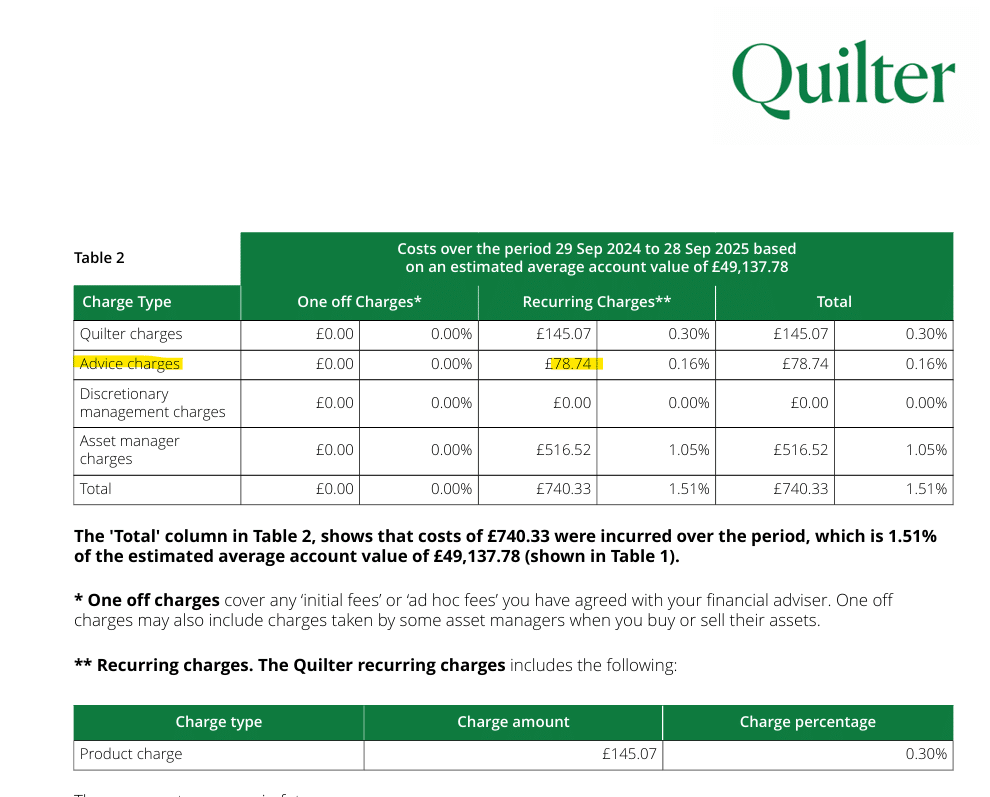
The screenshot above clearly shows how pension costs are split into different layers.
In this example:
- Advice charges: £78.74 (0.16%)
- Quilter product charge: £145.07 (0.30%)
- Asset manager (fund) charges: £516.52 (1.05%)
In this example, only the £78.74 advice fee would potentially fall within the £500 tax‑free pension advice allowance — the rest would not.
Why this matters
This £500 tax‑free pension advice allowance applies to financial advice only, not ongoing product or investment charges.
This is separate from:
- The platform/product charge (Quilter), and
- The investment/fund charges (asset managers)
👉 This distinction is important because:
- The £500 pension advice allowance can potentially cover the advice portion only
- It does not apply to product or fund charges
This is why it’s important to understand exactly what you’re being charged — and to ensure adviser fees are clearly separated and identifiable, so any available tax relief can be used properly.
Why this matters particularly for dentists
Dentists often have more complex retirement planning than most professionals, including:
- NHS Pension benefits alongside private or personal pensions
- Decisions around retirement timing and access
- Managing company profits tax‑efficiently
If pension advice is paid personally, it is paid from post‑tax income. Where the cost qualifies, having your company meet the cost instead can be a simple and effective tax saving.
HMRC rules in plain English
Under HMRC rules:
- Your company can provide, pay for, or reimburse up to £500 per tax year
- The first £500 is tax‑free
- If advice costs more than £500, only the excess is taxable
- The advice must relate specifically to pensions
- The exemption cannot be used via salary sacrifice
The exemption applies to directors as employees of their own limited company.
Adviser charges – what evidence is needed?
A financial adviser should be able to disclose their adviser charges, including:
- What is charged annually, and
- What portion of the fee relates specifically to pension advice
This information is typically available on:
- Adviser fee summaries
- Annual suitability reports
- Ongoing service agreements
- Pension platform statements
In practice, we usually see dentists provide:
- A PDF statement, or
- A screenshot showing the adviser name, the charge, and the amount applied in the tax year
This evidence supports the company reimbursement and aligns with HMRC expectations.
How your limited company can pay or reimburse the cost
There are three common and acceptable approaches:
- The company pays the adviser directly
Often the cleanest option. - You pay personally and reclaim the cost as an expense
The company reimburses you via the company bank account. - You pay personally and the company credits your director’s loan account
No immediate cash repayment is required.
Provided the advice qualifies and the £500 limit is not exceeded, there should be no personal tax charge.
Step‑by‑step: how dentists usually claim this correctly
Step 1 – Confirm adviser charges
Ask your financial adviser to confirm:
- Their annual charges, and
- What element relates specifically to pension advice
Step 2 – Check the limit
Ensure the amount claimed does not exceed £500 per tax year.
Step 3 – Choose how the company covers the cost
- Direct payment
- Expense reimbursement
- Director’s loan account credit
Step 4 – Record and retain evidence
Keep the adviser statement or screenshot with your company records in case of HMRC review.
What about earlier years?
Although claims cannot exceed £500 per tax year, it is often possible to:
- Review earlier years’ adviser charges, and
- Identify qualifying pension advice costs that were paid personally but never reimbursed by the company
Where those costs were genuinely incurred for pension advice and the company could have met the cost at the time, it may be possible to add expense claims for earlier periods, subject to normal company accounting and record‑keeping rules.
This does not increase the £500 tax‑free pension advice allowance, but it can allow dentists to tidy up missed claims from previous years.
Dentist’s checklist – does this apply to you?
Eligibility
- ⬜ You operate through a limited company
- ⬜ You are receiving pension‑related advice
- ⬜ Advice is provided by a regulated financial adviser
Evidence
- ⬜ Adviser fee statement or summary
- ⬜ Pension‑related element clearly identified
- ⬜ Amount capped at £500 per tax year
How it’s claimed
- ⬜ Company pays adviser directly or
- ⬜ Expense reimbursement or
- ⬜ Director’s loan account credit
Compliance
- ⬜ Not salary sacrifice
- ⬜ Records retained with accounts
A simple example
A dental limited company reimburses £500 of disclosed pension adviser charges relating to NHS pension and retirement planning.
- ✅ No Benefit‑in‑Kind
- ✅ No personal tax
- ✅ Corporation tax relief for the company
Our advice for dentist‑directors
This is a small but frequently missed planning point, particularly for dentists who:
- Already work with a financial adviser
- Pay ongoing adviser charges personally
- Operate through a limited company
If you’re unsure whether your adviser charges qualify — or whether you’ve missed claims in earlier years — it’s worth reviewing this properly.
Dentists book a review to see if you can claim the £500 tax‑free financial retirement advice
If you’re already paying for pension advice personally, there may be a simple way to make this more tax efficient through your company.
We can review:
- Whether you qualify for the £500 allowance
- Whether your adviser fees are structured correctly
- And ensure everything is recorded correctly in your accounts
Get in touch and we’ll walk you through it.
HMRC references
- HMRC Employment Income Manual EIM21802 – Pensions advice provided by an employer (pre‑6 April 2017 guidance)
- HMRC Employment Income Manual EIM21803 – Exemption for pensions advice – conditions to be satisfied (from 6 April 2017)
- Income Tax (Earnings and Pensions) Act 2003, section 308C – Statutory exemption for pensions advice
Frequently asked questions: tax-free pension advice for dentists
Can my dental limited company pay for pension advice?
Yes. If you operate through a limited company, HMRC allows your company to pay for or reimburse up to £500 per tax year of qualifying pension advice for you as a director, without creating a personal tax charge, provided the advice relates specifically to pensions.
Does this apply to NHS dentists?
Yes. This can apply to NHS dentists who operate through a limited company. The key point is that the advice must relate to pension planning and meet HMRC’s conditions — it is not restricted to private dentists.
Is the £500 tax‑free pension advice allowance available every year?
Yes. The £500 tax‑free pension advice allowance applies per tax year. You cannot exceed £500 in a single year, but it is possible to review earlier years if qualifying adviser charges were paid personally and not claimed at the time.
What does HMRC mean by “pension advice”?
HMRC restricts this exemption to advice relating to pension arrangements, pension benefits, and the tax implications of pension decisions. General investment advice or wider wealth planning does not qualify.
Do I need to be working with a financial adviser?
In practice, yes. This relief usually only applies where a regulated financial adviser is providing pension‑related advice and can clearly disclose the pension‑related element of their charges.
How does my company reimburse the cost?
Your company can pay the adviser directly, reimburse you through expenses, or credit the amount to your director’s loan account. All three approaches are acceptable, provided the conditions are met.
Does the £500 tax‑free pension advice allowance apply to sole traders and partnerships, or only limited companies that pay Corporation Tax?
This £500 tax‑free pension advice allowance applies only where pension advice is provided by an employer. In practice, that means it is relevant to limited companies, where the company is the employer and can pay for or reimburse the cost of qualifying pension advice.
It does not apply to sole traders or partnerships, as there is no separate employing entity in those structures. Sole traders and partners cannot use this specific exemption for pension advice paid personally.