Last updated: April 2026
Electric cars are becoming increasingly popular with dentists — whether you’re an associate commuting between practices or a practice owner looking to support staff and associate charging.
From 1 April 2026, the government improved and extended most EV charging grants. In many cases, support has increased from £350 to £500 per charging socket, with schemes now running until 31 March 2027.
This guide explains the current electric car and EV charging grants most relevant to dentists, with practical examples and clear next steps.
Table of Contents
Electric car grants for dentists – what changed in April 2026?
From April 2026, the Office for Zero Emission Vehicles (OZEV) made several important changes:
- ✅ EV charging grants increased to £500 per socket
- ✅ Home and workplace schemes extended until 31 March 2027
- ❌ Infrastructure‑only grants closed
- ✅ New “Find a grant” government application system introduced
These updates make EV charging more attractive and more valuable for dental practices in particular.
Electric Car Purchase Grant (ECG)
The Electric Car Grant provides an upfront discount on qualifying new electric vehicles. The discount is applied automatically by the dealer — there is no separate claim process.
How much is the Electric Car Grant?
- £3,750 for Band 1 electric vehicles
- £1,500 for Band 2 electric vehicles
Key rules dentists should know
- The car must be new and fully electric
- The list price is usually capped at £37,000
- Only vehicles on the official GOV.UK eligibility list qualify
- The grant is currently scheduled to run until 31 March 2030
Eligible models change regularly, so always check before ordering.
Home EV charging grants for dentists (April 2026 rules)
Home charging is often the cheapest way to run an electric car, but home EV grants are now targeted, not universal.
Who can claim a home EV charging grant?
From April 2026, dentists may qualify if they are:
- Renters with off‑street parking
- Flat owners with allocated parking
- Households with on‑street parking, using an approved cross‑pavement solution
❌ Dentists who own a house with a private driveway are not eligible under current rules.
How much can you claim?
- Up to £500 per charging socket
- Covers up to 75% of purchase and installation costs
- Available until 31 March 2027
Key practical points
- Installation must be completed by an OZEV‑approved installer
- Applications are made through the new Find a Grant service
- Grants cannot be backdated
- You normally need to own, lease, or have ordered an EV
Dentist examples
- Associate renting a flat with parking → eligible for £500
- Dentist with on‑street parking → eligible with council approval
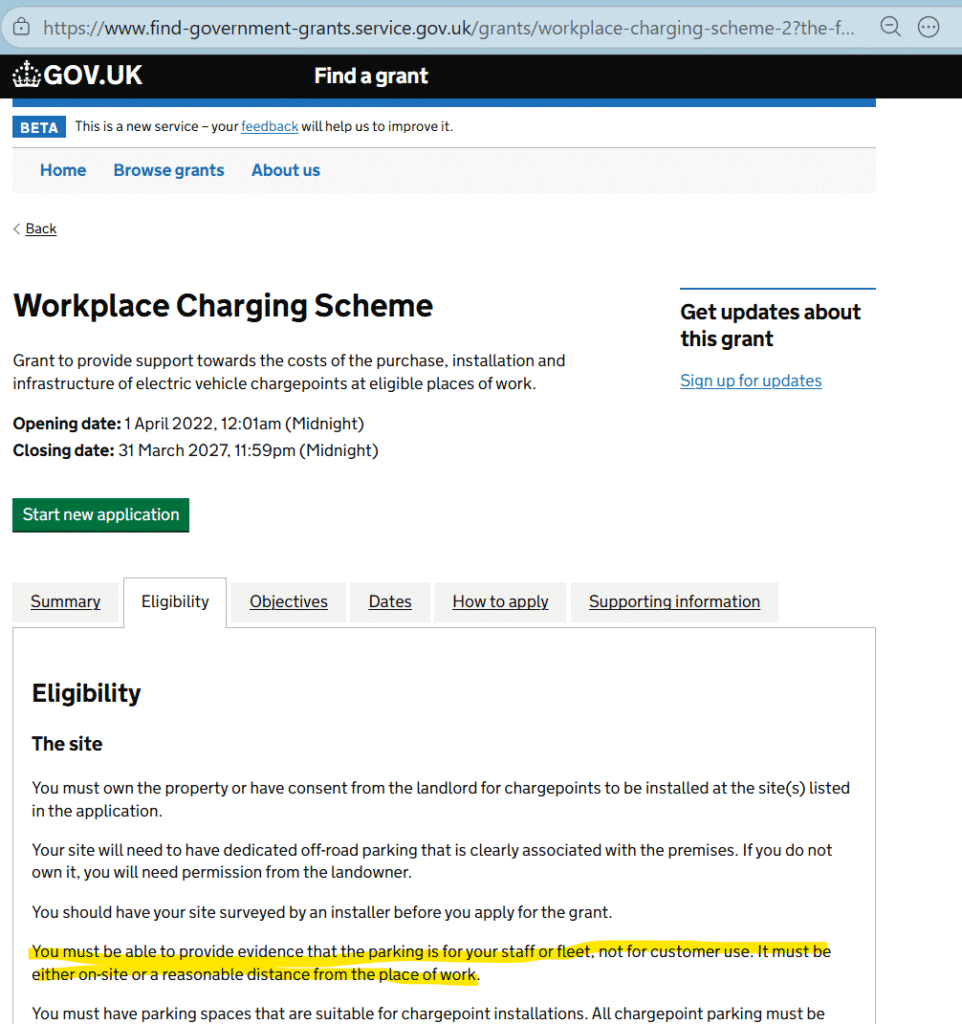
Workplace Charging Scheme (WCS) for dental practices and dental professionals with a home registered company
The Workplace Charging Scheme is now one of the most valuable EV grants available to dentists.
What’s available from April 2026?
- £500 per charging socket
- Up to 40 sockets per business
- Maximum support of £20,000
- Covers up to 75% of installation costs
- Extended until 31 March 2027
✅ The higher £500 rate applies based on the installation date, even if the voucher was issued earlier.
Who can apply?
- NHS and private dental practices
- Group practices
- Dentists with a company with a home‑registered Companies House address
Why this works particularly well for dentists
- Supports staff and associates who commute long distances
- Enhances sustainability credentials
- Charging provided to employees is not a taxable benefit
Can patients ever use WCS‑funded chargers?
For businesses, the guidance allows:
- ✅ Limited use by local residents outside normal working hours, when staff/fleet are not using the chargers
- ❌ Routine patient use during practice hours is not what the scheme is designed for
So while the charger doesn’t physically lock out patients, designing it primarily for patient charging creates compliance risk.
Dentist EV decision table – which route applies to you?
| Dentist situation | EV charging grant available? | Best route | Key notes |
|---|---|---|---|
| Renting a flat | ✅ Home EV grant | Personal | Needs an allocated parking spot |
| On‑street parking | ✅ Home EV grant | Personal | Council approval required |
| Owning house with driveway | ❌ No | N/A | Private driveway owners excluded |
| Practice owner (sole trader / partnership / LLP) | ✅ WCS | Practice pays | Unlikely to cover home location see FAQs below |
| A dental professional with a limited company registered at their home address | ✅ WCS (in most cases) | Company pays | Home install may qualify. Routine home work duties are needed to be undertaken to qualify. |
| Practice installing staff chargers | ✅ WCS | Practice pays | Tax free benefit for staff |
Tip: EV charging grant eligibility varies by business structure. Limited companies generally find it easier to qualify. Sole traders, LLPs and traditional partnerships are not excluded from the Workplace Charging Scheme, but home‑based applications are rarely accepted unless the home is a demonstrable place of work with dedicated business parking.
Infrastructure Grant for Staff and Fleets – now closed
The Electric Vehicle Infrastructure Grant for Staff and Fleets closed to new applications on 31 March 2026.
This grant previously funded cabling and electrical infrastructure for multi‑charger sites and is no longer available.
What dentists should do instead
- Use the Workplace Charging Scheme for individual chargers
- Plan electrical capacity carefully
- Consider phased installations
Practical EV charging tips for dentists
✅ You (the dentist or dental practice) must apply for the grant directly via the government’s
Find a Grant service
✅ An OZEV‑approved installer is still required, but they no longer apply on your behalf
(see GOV.UK – Changes to EV chargepoint grant schemes from 1 April 2026)
✅ The installer submits installation evidence and claims the grant after installation, using your approved application and voucher
✅ Confirm whether a home installation qualifies as workplace charging — this is particularly important for home‑registered limited companies (see clarification below)
✅ Installer availability tightens near the financial year‑end 31 March, so plan applications early (a practical, not regulatory, constraint)
✅ Any costs not covered by the grant may still qualify for tax relief, depending on whether the charger is installed personally or through the practice/company
Compliance note (home‑registered companies)
Where EV chargers are installed at a home address under the Workplace Charging Scheme, the home must be a genuine place of business — for example with a dedicated home office and company duties such as administration or management carried out there — not merely a Companies House registered office.
Home charging & company billing tip
Home charging billing tip (limited companies):
When charging a company car at home it’s possible to separate EV charging costs from general household electricity for company reimbursement purposes.
Some energy suppliers — such as Octopus Energy — offer EV‑specific tariffs and smart charging reports that can help identify electricity used for vehicle charging, allowing the limited company to reimburse or billed directly for charging costs without putting the entire domestic electricity bill through the company. Other suppliers offer similar smart‑meter‑based EV charging data.
This can be a practical alternative to installing a separate business electricity supply at home, keeping details of home charging history and tariff rates or business mileage.
VAT saving tip for practice owners
If you can charge your electric car either at home or at the dental practice, charging at home is usually cheaper. Domestic electricity is charged at 5% VAT, whereas electricity supplied to a dental practice is normally charged at 20% VAT.
Because most dental practices make VAT‑exempt supplies, that 20% VAT on practice electricity is usually irrecoverable, creating a permanent cost difference in favour of home charging — even where a workplace charger is available.
Electric car grants for dentists – FAQs
Can dentists get EV charging grants in 2026?
Yes. From April 2026, eligible dentists can claim up to £500 per socket through home EV charging grants or the Workplace Charging Scheme.
Can associate dentists use EV chargers funded by the Workplace Charging Scheme?
Yes. EV chargers installed under the WCS may be used by staff, which generally includes associate dentists working at the practice. The chargers must not be provided for patient or general public use.
Can dental practices install EV chargers for staff?
Yes. Dental practices can claim up to £20,000 under the Workplace Charging Scheme, and staff charging is a tax free benefit.
Do associate dentists qualify for EV grants?
Associates may qualify for home EV grants if they rent, live in a flat, or have on‑street parking. Homeowners with private driveways are excluded unless they have a register business at companies at their home address and undertake work tasks at their home address.
Can a limited company dentist claim EV charging grants?
Yes — in many cases.
A limited company can claim the Workplace Charging Scheme (WCS) where directors or company officers genuinely work from home and the home address operates as a real place of business, with dedicated off‑street parking used for company purposes.
Being registered at the address with Companies House on its own is not sufficient — the home must be actively used for company activities (such as administration or management) and meet the scheme’s site requirements.
Can a sole trader or partnership get the WCS when working from home?
Sole traders and traditional partnerships are not excluded from the Workplace Charging Scheme, but home‑based applications are rarely accepted unless the home is a demonstrable place of work with dedicated business parking. In practice, limited companies and LLPs find it easier to meet the scheme’s site requirements.
Even though they are technically eligible, most home‑based sole traders and partnerships fail because:
- ❌ The address is used mainly as a private residence
- ❌ Parking is shared domestic parking
- ❌ There are no employees or fleet vehicles
- ❌ The charger would realistically be for personal use
Installers and OZEV auditors are much stricter where there is no separate legal entity (unlike Ltd/LLP), because the boundary between personal and business use is harder to evidence.
Final thoughts for dentists
This guide focuses on grants and charging support, not the wider tax advantages of electric cars, which can be substantial — particularly for dentists operating through a limited company.
When grants and tax relief are combined, electric vehicles can be significantly cheaper than petrol or diesel alternatives.
If you’d like help deciding:
- whether to apply personally or through your practice
- how EV charging fits your business structure
- or the wider tax implications
Get in touch — we’re happy to help.